
The short answer
WHO recommends keeping free sugars below 10% of your daily energy (about 12 teaspoons), and ideally below 5% (about 6 teaspoons). ICMR-NIN suggests no more than 25–30 g (5–6 teaspoons) a day for Indians. Free sugars include sugar in chai, sweets, soft drinks, juices, biscuits and sauces, and also jaggery and honey. Cut down gradually: less sugar in tea, fewer sweet drinks, mithai only on occasions, and label-checking on packaged foods.
Our examples use Indian foods, but the same principles apply to any diet: more vegetables, whole grains and protein, and less sugar, salt and fried food.
How much sugar is too much?
| Guidance | Daily limit |
|---|---|
| WHO: maximum | Less than 10% of energy, about 50 g (12 teaspoons) |
| WHO: better for health | Less than 5% of energy, about 25 g (6 teaspoons) |
| ICMR-NIN (India) | 25–30 g (5–6 teaspoons) |
"Free sugars" means sugar added to foods and drinks, plus sugar in honey, syrups and fruit juice. The natural sugar in whole fruit and plain milk doesn't count.
Where the sugar hides in Indian diets
| Food or drink | Approx. sugar |
|---|---|
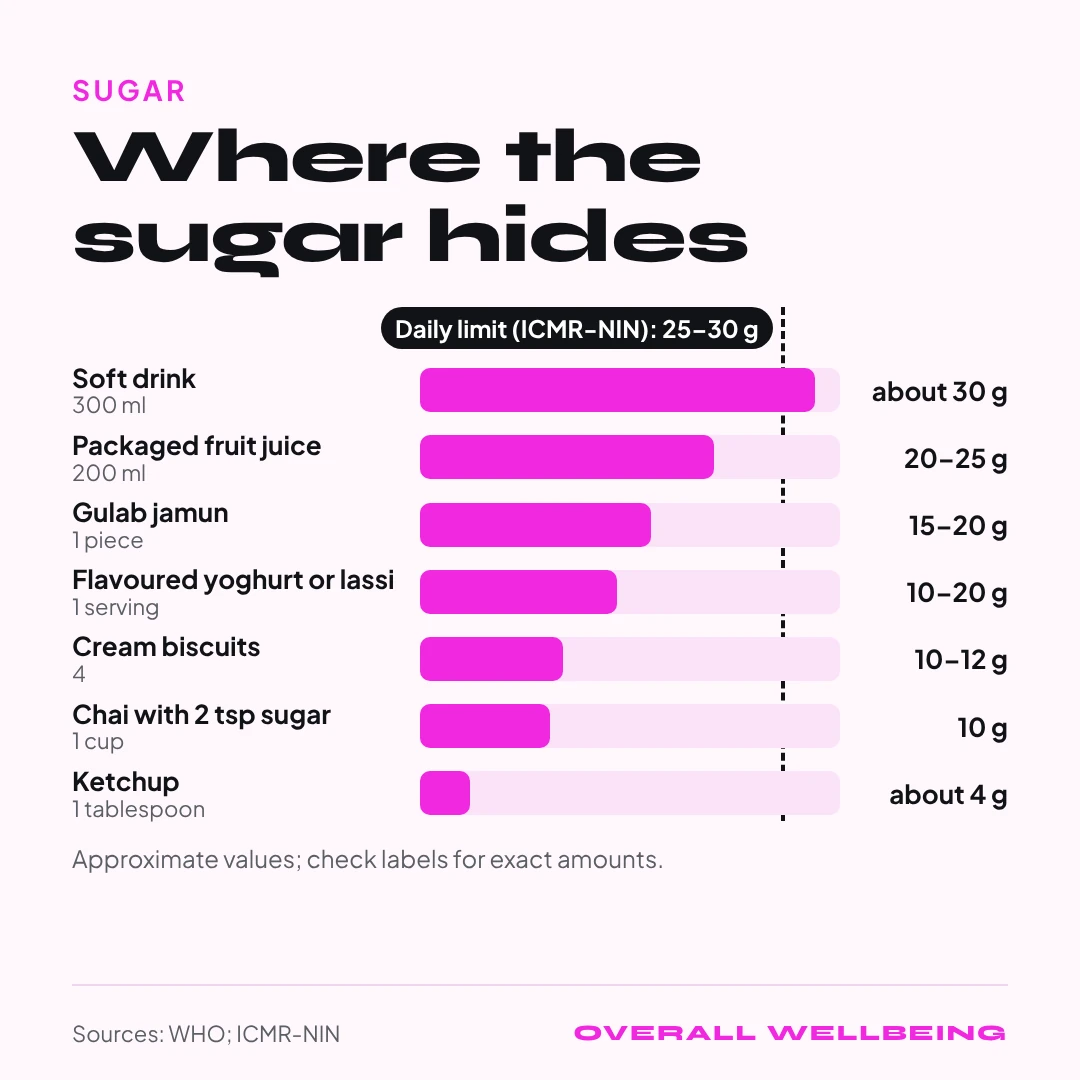
| Cup of chai with 2 tsp sugar | 10 g |
| Soft drink (300 ml) | about 30 g |
| Packaged fruit juice (200 ml) | about 20–25 g |
| 1 gulab jamun | about 15–20 g |
| 4 cream biscuits | about 10–12 g |
| Flavoured yoghurt or lassi | 10–20 g |
| Ketchup (1 tablespoon) | about 4 g |
Approximate values; check labels for exact amounts.
Three cups of sweet chai and one cold drink can add up to about 60 g of sugar, more than double the ICMR-NIN limit.
Practical steps
Beginner
- Reduce sugar in tea and coffee gradually. Cut by half a teaspoon every week or two; your taste adjusts.
- Swap sugary drinks for water, plain buttermilk, nimbu-pani without sugar, or coconut water.
- Keep sweets for occasions, not every day after meals.
Intermediate
- Eat whole fruit instead of juice. WHO advises limiting fruit juice, even unsweetened.
- Read labels. Look for sugar per 100 g, and words like sucrose, glucose, corn syrup, maltodextrin and jaggery.
- Make breakfast less sweet. Choose poha, upma, eggs or plain oats over sugary cereals and biscuits.
Advanced
- Plan for festivals. Enjoy a small portion of mithai, share sweets, and gift dry fruits or fruit baskets instead.
- Don't just switch to artificial sweeteners. WHO advises against using non-sugar sweeteners for weight control. It's better to get used to less sweetness.
Common myths
- "Jaggery and honey are healthy alternatives." ICMR-NIN treats them as sugar. They contain small amounts of minerals but are mostly sugar.
- "Fruit juice is as good as fruit." Juice has much less fibre and more concentrated sugar.
- "Sugar-free sweets are fine in any amount." They often still contain plenty of calories and fat.
Try this today
Reduce the sugar in each cup of tea or coffee by half a teaspoon.
When to see a doctor
See a doctor if you have frequent thirst, frequent urination, unexplained tiredness or weight loss, or a family history of diabetes. Simple blood tests can check your sugar levels.
Common questions
How much sugar per day is OK in India?
ICMR-NIN suggests no more than 25–30 g (5–6 teaspoons) a day.
Is jaggery better than sugar?
Not meaningfully. ICMR-NIN counts jaggery and honey as sugar.
How do I stop sugar cravings?
Cut down gradually, eat regular meals with protein and fibre, sleep well, and keep sweets out of easy reach. NOTE (pilot/batch 1 image suggestions): sleep-quality = calm dark Indian bedroom + 10-habits card + sleep-hours table; ease-of-falling-asleep = reading under soft lamp + 4-6 breathing diagram + 20-minute rule; stress-management = walking in park + signs chart; anxiety-and-worry-management = journalling + can solve/can't control worksheet; burnout = tired professional at laptop at night + 3 signs (WHO).
Sources
- Healthy diet — WHOstrong
- My Plate for the Day (policy brief) — ICMR-NINconsensus
- Dietary Guidelines for Indians — ICMR-NIN 2024consensus
Part of these Essentials
Related guides
In the same area of life
Healthy Indian diet plan for everyday life
Dietary variety
Nutrient-dense food intake
Fruit and vegetable intake
How much protein you need, with Indian vegetarian sources
Healthy dietary fat sources
Complex carbohydrate quality
Adequate dietary fiber
Build a calm, personal practice
Explore more of the framework, or open your personal Wellbeing space to focus on what matters most right now.