
Healthy Indian diet plan for everyday life
The short answer
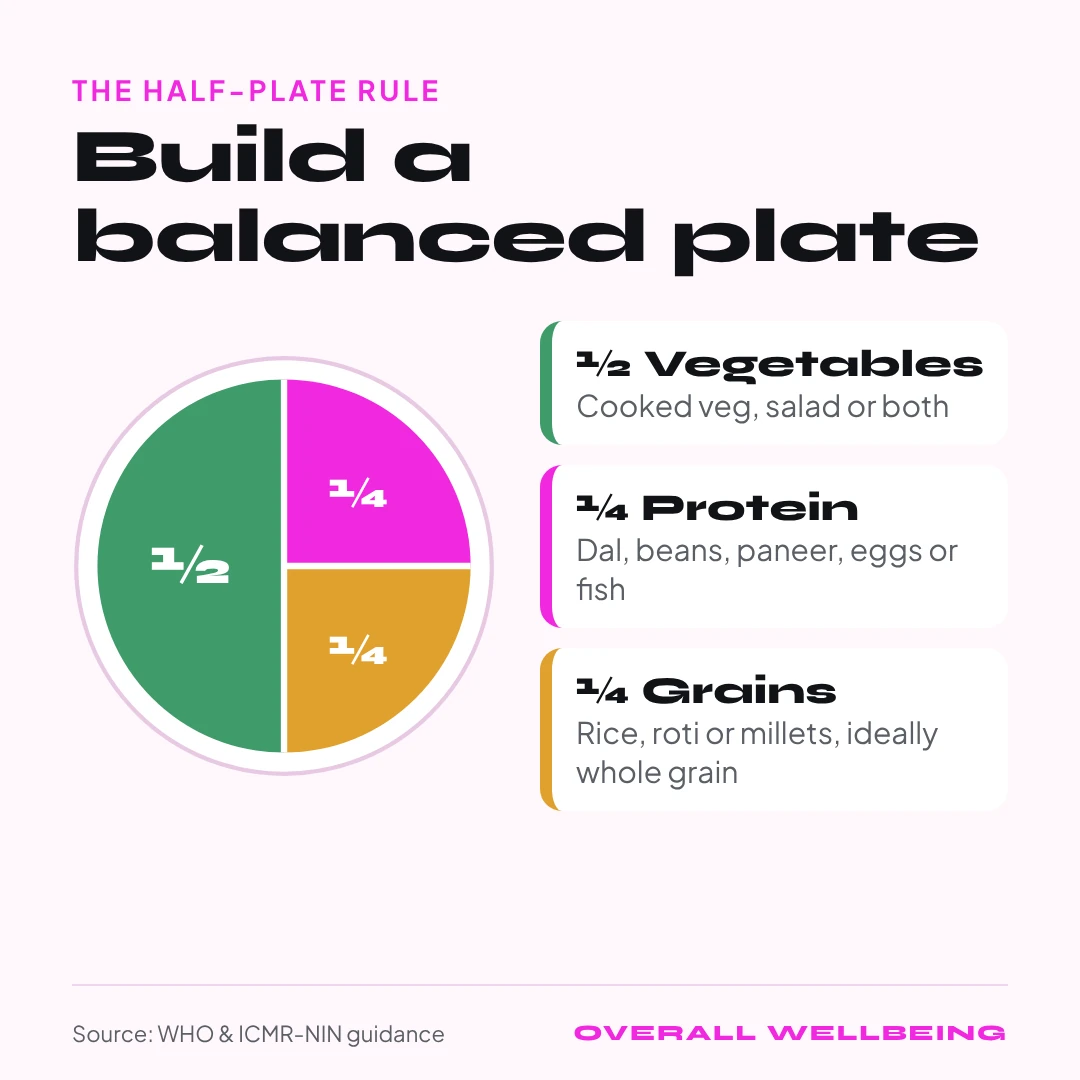
A healthy Indian diet doesn't need special foods. ICMR-NIN's My Plate for the Day recommends, for an average adult, about 250 g of cereals and millets, 85 g of pulses (or eggs, fish or meat), 300 ml of milk or curd, 400 g of vegetables including leafy greens, 100–150 g of fruit, 35 g of nuts and seeds, and about 27 g of oil a day, with little sugar and salt. In practice: half your plate vegetables, a quarter dal or protein, a quarter whole grains.
Our examples use Indian foods, but the same principles apply to any diet: more vegetables, whole grains and protein, and less sugar, salt and fried food.
My Plate for the Day (ICMR-NIN)
| Food group | Daily amount (about 2,000 kcal) | Examples |
|---|---|---|
| Cereals and millets | 250 g (raw) | Rice, wheat, bajra, jowar, ragi |
| Pulses, eggs, fish, meat | 85 g (raw) | Dal, chana, rajma, moong, eggs, fish, chicken |
| Milk and curd | 300 ml | Milk, curd, buttermilk |
| Vegetables (incl. leafy greens) | 400 g | Palak, methi, lauki, bhindi, beans, carrots |
| Fruits | 100–150 g | Seasonal fruit (not juice) |
| Nuts and seeds | 35 g | Peanuts, almonds, flaxseed, til |
| Fats and oils | 27 g (about 5–6 teaspoons) | Mix of oils: mustard, groundnut, rice bran, etc. |
Source: ICMR–National Institute of Nutrition, My Plate for the Day. Amounts vary with age, sex and activity.
ICMR-NIN also advises limiting sugar to about 25–30 g a day (about 5–6 teaspoons) and treating jaggery and honey as sugar.
A sample day (vegetarian)
| Meal | Example |
|---|---|
| Early morning | Water; a few soaked almonds or walnuts |
| Breakfast | Vegetable poha or upma with peanuts, or 2 besan cheelas with curd |
| Mid-morning | A seasonal fruit |
| Lunch | 2 rotis (or 1 katori rice), 1 katori dal, 1 katori sabzi, salad, curd |
| Evening | Tea with less sugar plus roasted chana, or buttermilk |
| Dinner | Millet roti or khichdi, 1 katori dal or paneer, 1–2 katoris vegetables |
Non-vegetarian option: replace some dal with eggs, fish or chicken.
Practical steps
Beginner
- Use the half-plate rule at lunch and dinner: half vegetables, a quarter protein, a quarter grains.
- Eat dal, beans or another protein at every main meal.
- Eat whole fruit, not juice. Juice, even unsweetened, contains a lot of sugar and little fibre.
Intermediate
- Mix in millets. Replace some rice or wheat with bajra, jowar, ragi or other millets a few times a week.
- Use less oil, and rotate oils. Measure oil with a spoon, and use a mix of oils rather than one.
- Cut salt. WHO recommends less than 5 g (about one teaspoon) of salt a day, including salt in pickles, papad, namkeen and packaged foods.
Advanced
- Read food labels. Check sugar, salt (sodium) and fat on packaged foods, as ICMR-NIN advises.
- Limit ultra-processed foods: biscuits, instant noodles, chips, sugary cereals and ready meals.
Common myths
- "Ghee is always healthy." Small amounts are fine, but ghee is high in saturated fat. Use it sparingly and mix oils.
- "Brown sugar or jaggery is healthy." They're still sugar.
- "Healthy eating is expensive." Dal, seasonal vegetables, local fruit and millets are among the most affordable foods.
Try this today
Add one extra serving of vegetables or leafy greens to lunch, and swap one packaged snack for fruit or a handful of nuts.
When to see a doctor or dietitian
If you have diabetes, kidney disease, high blood pressure, a thyroid condition or other health conditions, or are pregnant, ask your doctor or a registered dietitian to adjust this plan for you.
Common questions
How many rotis should I eat in a day?
It depends on your age, activity and goals. For many adults, 2 rotis per main meal alongside plenty of vegetables and dal is a reasonable start.
Is rice bad for health?
No. Rice is a staple cereal. Watch the portion size and pair it with dal and vegetables.
Do I need supplements on this diet?
Most healthy adults don't need supplements if they eat a varied diet. Some people, such as pregnant women or strict vegetarians, may need specific ones. Ask your doctor.
Sources
- My Plate for the Day (policy brief) — ICMR-NINconsensus
- Dietary Guidelines for Indians — ICMR-NIN 2024consensus
- Healthy diet — WHOstrong
Part of these Essentials
Related guides
In the same area of life
Dietary variety
Nutrient-dense food intake
Fruit and vegetable intake
How much protein you need, with Indian vegetarian sources
Healthy dietary fat sources
Complex carbohydrate quality
Adequate dietary fiber
Vitamin D and B12: food, sunlight and when to get tested
Build a calm, personal practice
Explore more of the framework, or open your personal Wellbeing space to focus on what matters most right now.