Strength training for beginners
The short answer
Strength training means making your muscles work against resistance: your body weight, water bottles, resistance bands or weights. WHO and NHS recommend strength exercises on at least 2 days a week, working the major muscle groups. It helps you stay strong and independent as you age, supports bones, joints, blood sugar and weight, and you can start at home with a chair and a wall.
Why strength matters
From middle age, muscle mass and strength gradually decline unless you use them. Regular strength training helps you:
- keep up daily activities like climbing stairs, lifting and carrying;
- support your bones and joints, and improve balance (fewer falls);
- help control blood sugar and weight;
- improve posture and reduce back pain.
A beginner home routine (twice a week)
Based on NHS strength exercises. Use a sturdy chair without wheels or arms.
| Exercise | How | Start with |
|---|---|---|
| Sit-to-stand | Sit at the edge of a chair, lean slightly forward, stand up using your legs, then sit down slowly | 5 slow reps; build to 10–12 |
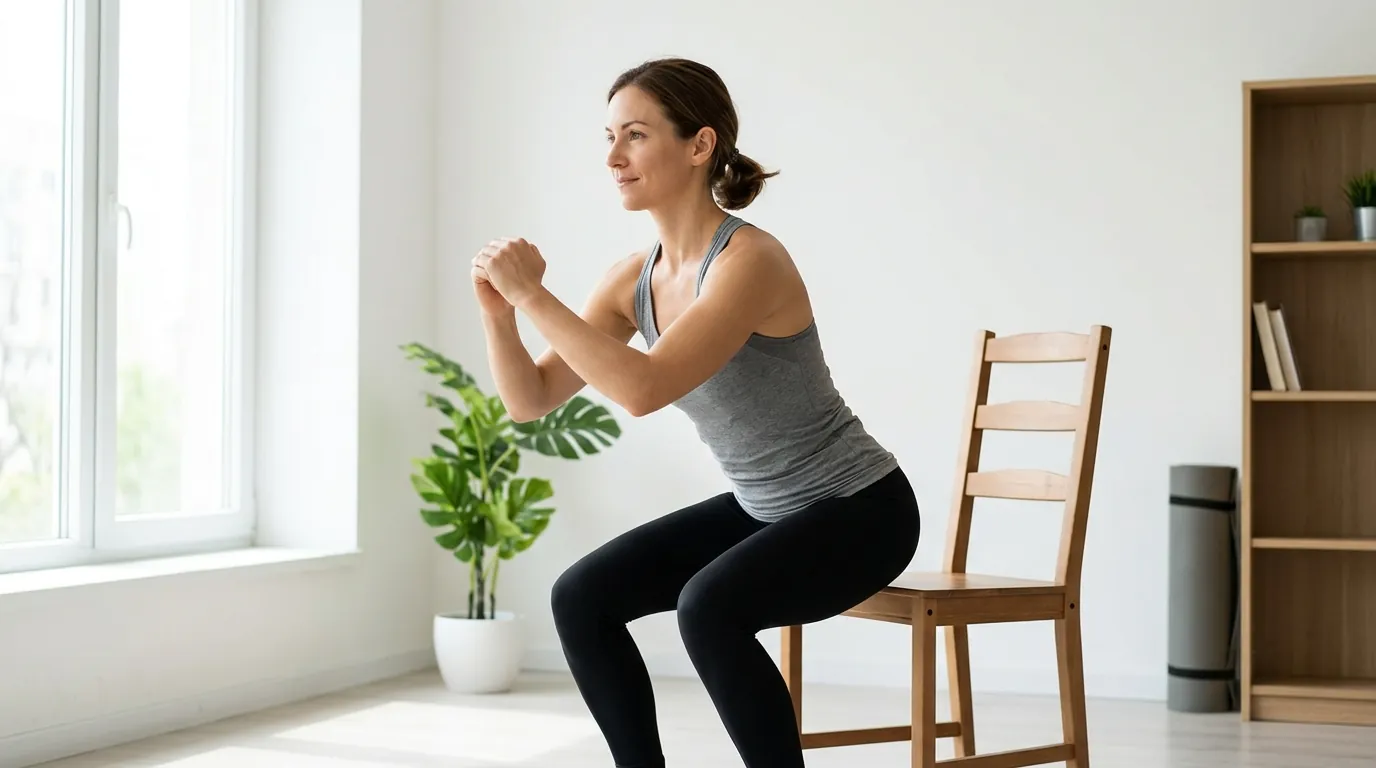
| Mini-squats | Hold the chair back, bend your knees as far as comfortable with a straight back, then stand | 5 reps; build to 10–12 |
| Wall push-ups | Hands on the wall at chest height, bend your elbows to bring your chest towards the wall, push back | 3 sets of 5–10 |
| Calf raises | Holding the chair, slowly lift both heels, then lower | 5 reps; build to 10–15 |
| Biceps curls | Hold filled water bottles, curl them up to your shoulders and lower slowly | 3 sets of 5 per arm |
| Bridge (on a mat) | Lie on your back, knees bent, lift your hips, hold 3 seconds, lower | 5–10 reps |
Rest 30–60 seconds between sets. Move slowly and with control.
How to progress
Start here (beginner)
- Twice a week, on non-consecutive days.
- Learn good form first: slow, controlled movements and a straight back.
- Breathe out as you push or lift; don't hold your breath.
Build on it (intermediate)
- Increase reps gradually, then add sets.
- Add resistance: resistance bands, heavier bottles or light dumbbells.
- Try harder versions: knee push-ups, full squats, lunges or planks.
Go further (advanced)
- Join a gym or class for guidance on weights.
- Combine strength with aerobic activity (walking, cycling) for overall fitness.
- Eat enough protein from food (see How much protein you need). Protein powders aren't necessary for most people.
Common myths
- "Strength training is only for young men." It benefits women and older adults too, maybe especially.
- "Lifting weights makes women bulky." Building large muscles takes intensive training; regular strength work makes you stronger and more toned.
- "I need a gym." A chair, a wall and water bottles are enough to start.
Try this today
Do 5 slow sit-to-stands from a chair, rest, and repeat twice.
When to see a doctor
Talk to a doctor or physiotherapist first if you have heart disease, uncontrolled blood pressure, recent surgery, osteoporosis, or joint or back problems. Stop if an exercise causes sharp pain.
Common questions
How often should beginners do strength training?
At least twice a week, with a rest day in between.
Can I build strength without weights?
Yes. Bodyweight exercises like squats, push-ups and bridges build strength.
Do I need protein powder?
Most people can get enough protein from food. ICMR-NIN advises against relying on protein supplements.
Sources
- Strength exercises — NHSstrong
- Physical activity guidelines for adults aged 19 to 64 — NHSstrong
- Physical activity — WHOstrong
Part of these Essentials
Related guides
In the same area of life
Cardiovascular health
Cardiovascular endurance
Resting heart rate
Heart rate variability (HRV)
High blood pressure: everyday habits that help bring it down
Circulatory health
Respiratory health
Respiratory rate
Build a calm, personal practice
Explore more of the framework, or open your personal Wellbeing space to focus on what matters most right now.